
NOTE: All of the yous and yours underlined as "you" and "your" indicates that the you and the your are plural. Also any of the words that are in pink lettering as "you" refers to the feminine gender, but it is only applied when it does not commonly refer to a woman. This only is applied to this week's Torah portion text at this time.
CHAPTER 26
Deuteronomy 26:1-19
Deu 26:1 And shall be, when you come to the land which יהוה, your Elohim, is giving to you of an inheritance, and you shall possess (occupy) her, and you shall dwell in her; 2 and you shall take from the first of all of the fruits of the Ground which you shall bring from your land which יהוה, your Elohim, is giving to you, and shall be put in a woven basket, and you shall walk to the Place which יהוה, your Elohim, shall choose to tabernacle His Name there. 3 And you shall come to the Priest which shall be in those days, and you shall say to him, I am declaring the day (today) to יהוה, your Elohim, for I have come to the land which יהוה swore to our fathers to give to us. 4 And the Priest shall take the woven basket from your hand, and shall rest him to the face of the Altar of יהוה, your Elohim. 5 And you shall answer, and you shall say to the Face of יהוה, your Elohim, My father was a wandering (perishing) Aramite, and descended to Egypt, and sojourned there among a few adult men, and became there for a nation great, bony and the multiple (multitude): 6 And the Egyptians, they were evil with us, and they afflicted us, and they gave hard bondage upon us: 7 and we cried to יהוה, Elohim of our fathers, and יהוה heard את-our voice, and saw את-our affliction, and את-our toil, and את-our oppression (distress): 8 And יהוה brought us out from Egypt on a Strong Hand, and on an Outstretched Arm, and on Great Aweness (Reverence, Fear, Terribleness, Terror), and on Signs, and on Miracles (Wonders): 9 and brought us to this Place, and has given to us את-this Land, a Land flowing with fatness (milk) and thickness (honey) [(fatness and thickness, milk and honey)]. 10 And now behold, I have brought את-the first of the fruit of the Ground which You have given her to me, יהוה. And you shall rest him to the Face יהוה, your Elohim, and you shall bow down to the Face of יהוה, your Elohim: 11 and you shall rejoice in all of the goodness which יהוה, your Elohim, has given to you, and to your household, you, and the Levite, and the sojourner which are in your drawing nearness.
12 When you have finished to the tithing of את-all from the tithes of your produce in the third year, the year of the tithe, and have given her to the Levite, to the sojourner, to the orphan (fatherless), and to the widow, and they shall eat in your gates, and they shall be satisfied; 13 And you shall say to the Face of יהוה, your Elohim, I have kindled away (fueled away) the Sacred Things (Holy Things) from the house, and also have given him to the Levite, and to the sojourner, to the orphan (fatherless), and to the widow, according to [(as)] all of Your Commandments which You have commanded me: I have not gone over from Your Commandments, and I did not forget: 14 I have not eaten from him in my iniquity (vanity, ?mourning?), and I have not kindled away (fueled away) from him in uncleanness, and I have not given from him to the dead: I have listened in the Voice of יהוה, my Elohim, I have done according to [(as)] all which You have commanded me. 15 Peep down (Lean out, Lean down) from Your Sacred (Holy) Habitation (Abode, Den) from the Heavens, and bless את-Your People, את-Israel, and את the Ground which You have given her to us, as the which You swore to our fathers of a land flowing with fatness (milk) and thickness (honey) [(fatness and thickness, milk and honey)].
16 This day יהוה, your Elohim, commands you to do את-these Statutes and את-the Judgments (Ordinances): you shall guard (observe, take heed) to do them in all of your heart, and in all of your soul. 17 You have said יהוה-את the day (today) to be to you for Elohim and to walk in His Ways, and to guard (observe, heed) His Statutes, and His Commandments, and His Judgments (Ordinances), and to listen in His Voice: 18 And יהוה has said to you the day (today) to be to Him of a People, of a Special Treasure, as the which had spoken to you, and to guard (observe, heed) all of His Commandments; 19 And to give yourself ascending (high) above (upon) all of the nations which is done (made) for praise, and for name, and for glory; and for you to be a Sacred (Holy) People to יהוה, your Elohim, as the which has spoken.
(NOTE: Not all verses will have comments)
Verses one through four
1 And shall be, when you come to the land which יהוה, your Elohim, is giving to you of an inheritance, and you shall possess (occupy) her, and you shall dwell in her; 2 and you shall take from the first of all of the fruits of the Ground which you shall bring from your land which יהוה, your Elohim, is giving to you, and shall be put in a woven basket, and you shall walk to the Place which יהוה, your Elohim, shall choose to tabernacle His Name there. 3 And you shall come to the Priest which shall be in those days, and you shall say to him, I am declaring the day (today) to יהוה, your Elohim, for I have come to the land which יהוה swore to our fathers to give to us. 4 And the Priest shall take the woven basket from your hand, and shall rest him to the face of the Altar of יהוה, your Elohim.
The men of Israel who brought their first fruits to Jerusalem would say this statement, because hwhy wanted them to remember the First Word (Commandment) which Moses reiterated multiple times throughout a good part of the Torah, which is noted in the Torah portion of Yithro, in the book of Exodus
Exodus 20:2 I am יהוה, your Elohim, which brought you out from the land of Egypt, from the house of bondages (slaves, slavery).
Also, in their future, the men would say this in order to make them remember in the future when they observe Passover, their sons would ask them a question, which is noted in the Torah portion of Bo, in the book of Genesis
Exodus 12:26 And shall be, when your sons, they shall say to you, What is this service to you? 27 And you shall say, He is the Passover to יהוה which passed by over (upon) the houses of the Sons of Israel in Egypt, in His plaguing (goreing, stumbling) את-Egypt, and delivered (rescued) את-our houses....
Verses four and five
4 And the Priest shall take the woven basket from your hand, and shall rest him to the face of the Altar of יהוה, your Elohim. 5 And you shall answer, and you shall say to the Face of יהוה, your Elohim, My father was a wandering (perishing) Aramite, and descended to Egypt, and sojourned there among a few adult men, and became there for a nation great, bony and the multiple (multitude):
This was referring to Jacob. Abraham and Isaac were also wandering Aramites as noted in the Torah portion of Vay-Yeyra and Vay-Yishlakh, in the the book of Genesis
Genesis 20:1 And Abraham pulled up (journeyed) from there to the land of the Negeb, and dwelled between Kadesh and between Shur, and sojourned in Gerar.
Genesis 21:34 And Abraham sojourned in the land of the Philistines many days.
Genesis 35:27 And Jacob came to Isaac, his father, at Mamre, at the city of the Arbah, she is Hebron, which Abraham and Isaac sojourned there.
We as believers in the Messiah are also wandering Aramites, wandering from our own lands of this world, and following יהוה, our Heavenly Father. We are also spiritual wonderers of this spiritual world in Messiah, which is based in Yeshua's statement to the Pharisees, which is noted in the Gospel of John
John 8:23 And He said unto them, Ye are from beneath; I am from above: ye are of this world; I am not of this world.
The apostle Paul noted this in his letter to the assembly in Ephesus
Ephesians 2:19 Now therefore ye are no more strangers and foreigners, but fellowcitizens with the saints, and of the Household of יהוה;
We who accepted Yeshua are also called the children of Abraham, which the apostle Paul noted in his letter to the assembly at Galatia
Galatians 3:6 Even as Abraham believed יהוה, and it was accounted to him for righteousness. 7 Know ye therefore that they which are of faith, the same are the children of Abraham. 8 And the scripture, foreseeing that hwhy would justify the heathen through faith, preached before the Gospel unto Abraham, saying, In thee shall all nations be blessed. 9 So then they which be of faith are blessed with faithful Abraham.
Verses twelve through fifteen
12 When you have finished to the tithing of את-all from the tithes of your produce in the third year, the year of the tithe, and have given her to the Levite, to the sojourner, to the orphan (fatherless), and to the widow, and they shall eat in your gates, and they shall be satisfied; 13 And you shall say to the Face of יהוה, your Elohim, I have kindled away (fueled away) the Sacred Things (Holy Things) from the house, and also have given him to the Levite, and to the sojourner, to the orphan (fatherless), and to the widow, according to [(as)] all of Your Commandments which You have commanded me: I have not gone over from Your Commandments, and I did not forget: 14 I have not eaten from him in my iniquity (vanity, ?mourning?), and I have not kindled away (fueled away) from him in uncleanness, and I have not given from him to the dead: I have listened in the Voice of יהוה, my Elohim, I have done according to [(as)] all which You have commanded me. 15 Peep down (Lean out, Lean down) from Your Sacred (Holy) Habitation (Abode, Den) from the Heavens, and bless את-Your People, את-Israel, and את the Ground which You have given her to us, as the which You swore to our fathers of a land flowing with fatness (milk) and thickness (honey) [(fatness and thickness, milk and honey)].
This is the same information that is noted in the Torah portion of R'ey, in the book of Deuteronomy
Deuteronomy 14:28 Of the end of three years, you shall bring out את-all of the tithe of your produce in that year, and you shall deposit (make rest) in your gates: 29 and the Levite shall come, for does not belong to him a portion and an inheritance with you, and the sojourner, and the orphan, and the widow, which are in your gates, and they shall eat, and they shall be satisfied; by that, יהוה, your Elohim, shall bless you in all of the doing (work) of your hand which you do.
This is saying that every three years, by the end of the third year, one is to tithe the increase and give it to the Levite, the stranger, the fatherless and the widow within your gates.
British theologian, Charles John Ellicott, noted this in his commentary of verse twenty eight of R'ey's passage:
"This is called by the Jews Ma’aser ‘Ani, “the poor’s tithe.” They regard it as identical with the second tithe, which was ordinarily eaten by the owners at Jerusalem; but in every third and sixth year was bestowed upon the poor."
"The Poor's Tithe" is a good term.
There are four types of people mentioned that are to receive the tithe, and there are reasons for that:
The Levites: They don't have an inheritance
The Strangers: They don't have a place to live
The Widows: They don't have a husband
The Orphans: They don't have a father
All four types of these peoples lack a man figure of some sorts that would provide substance. Both the Levites and the Strangers do not have homes that a man in general is to possess. The widow and the orphan do not have male role models to lead them in the homes.
Jim Staley, formerly of Passion For Truth Ministries, noted that the third year of the tithe would have occurred during the third and sixth years in a seven year cycle, and he based it on the third and sixth days of creation, which is noted in the Torah portion of B'reyshith, in the book of Genesis
Genesis 1:9 And Elohim said, The waters from under the Heavens, they shall be collected to one place, and the dry place, she shall appear, and became so. 10 And Elohim called to the dry land Earth, and to the collection of the waters were called Seas, and Elohim saw for goodness. 11 And Elohim said, The Earth, she will sprout Sprouts, the Herb shall with the seeding of Seed, and Fruit Trees shall do (make) fruit to his kind which his seed is in him upon the Earth, and became so. 12 And the Earth, she brought out Sprouts, the Herb was with seeding Seed to his kind, and Trees did (made) Fruit which his seed is in him to his kind. And Elohim saw for goodness. 13 And became mixing period (evening), and became breaking period (morning): Third day.
Genesis 1:26 And Elohim said, We will do (make) Adam in Our Image according to Our Likeness, and shall rule among the fishes of the Sea, and among the birds of the Heavens, and among the animals, and among all of the Earth, and among all creepers that creep upon the Earth. 27 And Elohim created את the Adam in His Image, created him in the Image of Elohim, created them a remembered one (male) and a perforated one (punctured one, female). 28 And Elohim blessed them, and Elohim said to them, Fructify and multiply, and fill את-the Earth, and subdue (subject) her; and rule among the fish of the Sea, and among the birds of the Heavens, and among all living beasts that creep upon the Earth. 29 And Elohim said, Behold, I have given to you את-every herb seeding Seed which is upon the face of all of the Earth, and את-every Tree which in him is the Fruit of the Tree seeding Seed, to you shall be for food. 30 And to every beast of the Earth, and to every flier (bird) of the Heavens, and to every creeper upon the Earth which in him is a living soul, את-every Green Herb shall be for food, and became so. 31 And Elohim saw את-all which was done (made), and behold were much goodness. And became mixing period (evening), and became breaking period (morning): Sixth day.
The point Jim Staley made was that the third day was the day hwhy made the herbs (and could be grain as well) and the fruit trees, and the sixth day was when He made mankind.
CHAPTER 27
Deuteronomy 27:1-26
Deu 27:1 And Moses and the Elders of Israel commanded את-the People, to say, Guard (Observe, Heed) את-all of the Commandment which I am commanding you the day (today). 2 And shall be in the day which you go over את-the Jordan to the Land, which יהוה, your Elohim, is giving to you, you shall raise (erect) for yourself Great Stones, and you shall plaster (lime) them in the Plaster (Lime): 3 And you shall write upon them את-all of the Words of this Teaching (Torah) in your going over, by that, which you shall go to the land which יהוה, your Elohim, is giving to you of a land flowing with fatness (milk) and thickness (honey) [(fatness and thickness, milk and honey)]; as the which יהוה, Elohim of your fathers, has spoken to you. 4 And shall be in your going over the Jordan, you shall raise (erect) את-these stones on Mount Ebal which I am commanding you the day (today), and you shall plaster (lime) them on the Plaster (Lime). 5 And you shall build there an Altar to יהוה, your Elohim, an Altar of stones: you shall not wave (quiver, shake, vibrate, shock) iron upon them. 6 You shall build את-the Altar of יהוה, your Elohim, of peaceable (whole, uncut) Stones: and you shall elevate upon him Elevation Offerings (Ascension Offerings, Burnt Offerings) to יהוה, your Elohim: 7 And you shall sacrifice Peace Offerings, and you shall eat there, and you shall rejoice to the Face of יהוה, your Elohim. 8 And you shall write את-all of the Words of this Teaching (Torah), goodly (well) bore-dugged (dugged, plain ?explained?), upon the Stones.
9 And Moses and the Priests, the Levites, spoke to all of Israel, to say, Be sah'khath-silent (sah'khath-observe quietly), and hear, Israel; this day you have become for a People to יהוה, your Elohim. 10 And you shall hear (listen) in the Voice of יהוה, your Elohim, and you shall do את-His Commandments and את-His Statutes which I am commanding you the day (today).
11 And Moses commanded את-the People on that day, to say, 12 These, they shall stand to bless את-the People upon Mount Gerizim in your going over את-the Jordan; Simeon, and Levi, and Judah, and Issachar, and Joseph, and Benjamin: 13 and these, they shall stand upon the despisement (kalal-curse) on Mount Ebal; Reuben, Gad, and Asher, and Zebulun, Dan, and Naphtali.
14 And the Levites, they shall answer, and they shall say to all of the Men of Israel of a raised (high) voice,
15 Ah'roor-Cursed is the man who makes a vessel image (carved image) and a casted image (molten image, poured image), an abomination (abhorrence) of יהוה, the doing (work) of the hands of a craftsman (engraver), and is put in the secrecy. And all of the People, they shall answer, and they shall say, Amen.
16 Ah'roor-Cursed is a despiser (viler, kalal-curser) of his father and his mother. And all of the People shall say, Amen.
17 Ah'roor-Cursed is a retreater (remover) of a border (landmark) of his neighbor. And all of the People shall say, Amen.
18 Ah'roor-Cursed is a strayer (deceiver) of the blind in the way. And all of the People shall say, Amen.
19 Ah'roor-Cursed is a wrestler (perverter, stretcher) of the judgment of a sojourner, an orphan (fatherless) and a widow. And all of the people shall say, Amen.
20 Ah'roor-Cursed is a layer with the woman (wife) of his father; for has exposed (uncovered) the wing (skirt) of his father. And all of the People shall say, Amen.
21 Ah'roor-Cursed is a layer with any animal. And all of the People shall say, Amen.
22 Ah'roor-Cursed is a layer with his sister, the daughter of his father, or the daughter of his mother. And all of the People shall say, Amen.
23 Ah'roor-Cursed is a layer with his mother-in-law. And all of the People shall say, Amen.
24 Ah'roor-Cursed is a striker of his neighbor in the secrecy. And all of the People shall say, Amen.
25 Ah'roor-Cursed is a taker of a bribe (reward) to the striking a soul of innocent blood. And all of the People shall say, Amen.
26 Ah'roor-Cursed which does not raise all of את-the Words of this Teaching (Torah) to do them. And all of the People shall say, Amen.
26 Ah'roor-Cursed who does not rises up (lifts up) all of את-the Words of this Teaching (Torah) to do them. And all of the People shall say, Amen.
(NOTE: Not all verses will have comments)
Verse four
4 And shall be in your going over the Jordan, you shall raise (erect) את-these stones on Mount Ebal which I am commanding you the day (today), and you shall plaster (lime) them on the Plaster (Lime).
Looking at the word PLASTER
The Hebrew word for plaster is "seed"- Shin, Yod, Dalet (שיד). It is from Strong's Concordance number 7874, and its definition
A primitive root probably meaning to boil up (compare H7736); used only as denominative from H7875; to plaster: - plaister.
from 7875 "seed" (שיד), and its definition
From H7874; lime (as boiling when slacked): - lime, plaister.
from 7736 "shood" (שוד), and its definition
A primitive root; properly to swell up, that is, figuratively (by implication of insolence) to devastate: - waste.
This is where we get our modern English word "sod". There was not another altar like it, and it was convenient that it was under Joshua's watch (in Hebrew, Y'hoshua, meaning "Yah Saves") that the altar on Mount Ebal was made. Thus Yeshua (Hebrew for "salvation") is the Living Word made Flesh. Since flesh originally came from the dirt, or the "sod", it was clear that this altar represented Yeshua, the Living Word who became Flesh, which is noted in the Gospel of John
John 1:1 In the beginning was the Word, and the Word was with Elohim, and the Word was Elohim. 2 The Same was in the beginning with Elohim. 3 All things were made by Him; and without Him was not any thing made that was made.... 14 And the Word was made Flesh, and dwelt among us, (and we beheld His Glory, the Glory as of the Only Begotten of the Father,) full of Grace and Truth.
!!!כבד לך יהוה
Verse five
5 And you shall build there an Altar to יהוה, your Elohim, an Altar of stones: you shall not wave (quiver, shake, vibrate, shock) iron upon them.
This was fulfilled in the book of Joshua
Joshua 8:30 Then Joshua built an altar unto יהוה Elohim of Israel on Mount Ebal, 31 As Moses the servant of יהוה commanded את-the Sons of Israel, as it is written in the scroll of the Torah of Moses, an altar of whole stones, over which no man hath lift up any iron: and they elevated Elevation Offerings unto יהוה, and sacrificed Peace Offerings. 32 And he wrote there upon the stones ta a copy of the Torah of Moses, which he wrote toward the faces of the Sons of Israel.
This is similar to what King Solomon did when he was building the Temple of יהוה in Jeruslaem, which is noted in the book of the Kings
1 Kings 6:7 And the House, when it was in building, was built of stone made ready before it was brought thither: so that there was neither hammer nor axe nor any tool of iron heard in the house, while it was in building.
The altar on Mount Ebal, as well as the Temple of יהוה, were types and shadows of Yeshua, who was the Word made Flesh as noted in the Gospel of John, which I noted earlier.
These two altars by Joshua and King Solomon were made in the land of Israel.
Verse seven
7 And you shall sacrifice Peace Offerings, and you shall eat there, and you shall rejoice to the Face of יהוה, your Elohim.
Jacob and Laban made a covenant and did this similar thing, which is noted in the Torah portion of Vay-Yeytsey, in the book of Genesis
Genesis 31:44 And come now, we will cut a covenant, me and you; and shall be for a witness (testimony) between me and between you. 45 And Jacob took a stone and erected her of a pillar (column). 46 And Jacob said to his brothers, Glean stones; And they took stones, and they did (made) a heap: and they ate there upon the heap. 47 And Laban called to him Jegar Sahadutha: and Jacob called to him Galeed. 48 And Laban said, This heap is a witness (testimony) between me and between you today (the day). Upon thus his name was called Galeed; 49 And the Mizpah; which was said, יהוה shall watch between me and between you, for we are absent (hidden) a man from his neighbor. 50 If you shall afflict את-my daughters, and if you take wives upon my daughters, no man is with us; See, Elohim is a Witness (Testimony) between me and between you. 51 And Laban said to Jacob, Behold this heap and behold the pillar (column) which I have instructed (taught) between me and between you; 52 This heap is a witness (testimony), and the pillar (column) is a witness (testimony), if I, I will not go over את-this heap to you, and if you, you will not go over את-this heap and את-this pillar (column) to me for evil (evilness). 53 The Elohim of Abraham, and the Elohim of Nahor, the Elohim of their father, they shall judge between us. And Jacob sware in the dread of his father, Isaac. 54 Then Jacob sacrificed a sacrifice on the mountain, and called to his brothers to eat bread: and they ate bread, and they lodged (stayed) on the mountain.
Just like what Joshua and the Israelites would do at Mount Ebal.
Mark Biltz of El Shaddai Ministries noted that we in Yeshua are living stones. Adding on to this, we are the living stones that build His Altar. As Yeshua pours His Blood upon us, the "plaster of the Word", covering our sins, we as living stones as part of His Altar are being poured by His Blood continually, like a sacrifice's blood being poured on the altar at the Tent of Appointment.
Verse nine
9 And Moses and the Priests, the Levites, spoke to all of Israel, to say, Be sah'khath-silent (sah'khath-observe quietly), and hear, Israel; this day you have become for a People to יהוה, your Elohim.
This is the first time that Moses said this to the Israelites, "be silent". He did not have to say this to them before. Was there talking among the Israelites when Moses said this to them, or was Moses really saying "Close your mouth and open your ears"? It was most likely that it was the latter.
It is similar to what King David noted in the book of the Psalms
Psalms 46:10 Be still, and know that I am Elohim:
The apostle James could have noted this verse from this week's Torah portion passage indirectly, which is noted in his epistle
James 1:19 Wherefore, my beloved brethren, let every man be swift to hear, slow to speak, slow to wrath:
Verse ten
10 And you shall hear (listen) in the Voice of יהוה, your Elohim, and you shall do את-His Commandments and את-His Statutes which I am commanding you the day (today).
On the day יהוה spoke the Ten Words (Commandments) to the People with thunder, lightning and sounds in the Thick Cloud at Mount Sinai, the Israelites said this to Moses, which is noted in the Torah portion of Yithro, in the book of Exodus
Exodus 20:19 And they said to Moses, You speak with us, and we will listen: And let not Elohim speak with us, facing (lest) we die [(facing (lest) we be the death)].
The reason for Moses saying this in this week's Torah portion passage, because for one, Moses was about to die, and Joshua was about to take over the leadership. Moses wants the Men of Israel to hear יהוה's Voice themselves, by telling them, "You hear יהוה's Voice".
Verses eleven through thirteen
11 And Moses commanded את-the People on that day, to say, 12 These, they shall stand to bless את-the People upon Mount Gerizim in your going over את-the Jordan; Simeon, and Levi, and Judah, and Issachar, and Joseph, and Benjamin: 13 and these, they shall stand upon the despisement (kalal-curse) on Mount Ebal; Reuben, Gad, and Asher, and Zebulun, Dan, and Naphtali.
Looking at the word GERAZIM
The Hebrew word for Gerazim "G'ree-zeem"- Gimel, Resh, Zayim, Yod, Mem Sophit (גרזים). It is from Strong's Concordance number 1630, and its definition
Plural of an unused noun from H1629 (compare H1511), cut up (that is, rocky); Gerizim, a mountain of Palestine: - Gerizim.
from 1629 "gah-rahz" (גרז), and its definition
A primitive root; to cut off: - cut off.
This is the mountain they would say the blessings. One can say that those who receive the blessings would "cut off" their enemies from the land. Also notice that this word sounds a lot like our modern English word "grazing". A domesticated animal, like a cow, "grazes" on grass. This also means that if the Israelites obey יהוה's Word, they would be blessed with the fruitness of the land, and they would be able to "graze" the land. This also applies to us as believers if we obey our Heavenly Father, that we would be blessed and we can spiritually "graze" the benefits of His Blessings, whether by missions, congregations, ministries, etc.
I noticed that it did not say either Ephraim and Manasseh, but "Joseph". Why? Becuase it reveals that the tribe of Levi is mentioned as one of the six tribes to go up to Mount Gerizim. This would be the first time that the Tribe of Levi was mentioned as part of the twelve tribes since they became the Priests. Why were they included to go on the mountain? Because they are part of the twelve tribes of Israel who would settle in the land, and hwhy wanted that particular tribe to be part of the six tribes to provide the blessing. This is symbolic, and it signifies that a certain future "Levite" will come to earth to provide "Eternal Blessings", and provide them to be "cut off" from the world. That Levite is "Yeshua", the last legitimate Levitical High Priest on earth, and was and still is the Eternal High Priest after the order of Melki Tsedek.
Indirectly related, the tribe of Levi are also mentioned to be part of the 144,000 in the end times that will have the seal of יהוה on their foreheads, which is noted in the book of Revelation
Revelation 7:7 ...Of the tribe of Levi were sealed twelve thousand....
Looking at the word EBAL
The Hebrew word for Ebal is "Ey-vahl"- Ayin, Yod, Bet, Lamed (עיבל). It is from Strong's Concordance number 5858, and its definition
Perhaps from an unused root probably meaning to be bald; bare; Ebal, a mountain of Palestine: - Ebal.
This is the mountain they were to use for the cursings. This Hebrew word is where we most likely get our modern English word "bald", with the "d" most likely added later throughout the centuries. If the Israelites did not obey the Word of יהוה, their land would be "bald". This also applies to us as believers if we don't disobey the Heavenly Father's Will, we will not be blessed, and our spiritual fruition will we "bald".
These two mountains were located in Shechem. Jim Staley, formerly of Passion For Truth Ministries, noted that it was the same location that Abram journeyed from the Kasdim, which is noted in the Torah portion of Lekh L'kha, in the book of Genesis.
Genesis 12:6 And Abram went over in the land unto the place of Shechem, unto the Oak of Moreh, and the Canaanite was then in the land. 7 And hwhy appeared to Abram, and said, I will give את-this land to your seed: And built there an altar to יהוה that appeared to him,
As Bill Cloud of Shoreshim Ministries, and Brad Scott of Wildbranch Ministry say that history repeats itself, and that history comes full circle. This is the very case when the Israelites will cross over the Jordan to the land that they will be arriving at the very place their ancestor, Abraham, made an altar to יהוה after יהוה talked to him to leave the land of his nativity. Jim Staley, formerly of Passion for Truth ministries, also noted that Shechem was also the place where Jacob buried all the idols whom his household and his servants possessed, which is noted in the Torah portion of Vay-Yishlakh, in the book of Genesis
Genesis 35:1 And Elohim said to Jacob, Arise, ascend at Beth El, and dwell there: and do (make) there an altar to The El that appeared to you in your bolting away (running away) from the face of Esau, your brother. 2 And Jacob said to his house and to all which were with him, Remove (Put away) את-the foreign elohim which are in your midst, and purify, and change your clothing: 3 and we will arise, and we will ascend at Beth El; and I will do (make) there an altar unto The El that answered me in the day of my distress, and was with me in the way at which I went. 4 And they gave to Jacob את all of the foreign elohim which were in their hand, and את-their nose rings (earrings) which were in their ears; and Jacob privately hid them under the oak tree which was from Shechem.
Jim Staley noted that the word Moreh during the time of Abraham noted above.
Looking at the word MOREH
The Hebrew word for Moreh is "Moh-reh"- Mem, Vav, Resh, Heh (מורה). It is from Strong's Concordance number 4176, and its definition
The same as H4175; Moreh, a Canaanite; also a hill (perhaps named from him): - Moreh.
from 4175 "moh-reh" (מורה), and its definition
From H3384; an archer; also teacher or teaching; also the early rain (see H3138): - (early) rain.
from 3384 "yah-rah" (ירא ,ירה), and its definition
A primitive root; properly to flow as water (that is, to rain); transitively to lay or throw (especially an arrow, that is, to shoot); figuratively to point out (as if by aiming the finger), to teach: - (+) archer, cast, direct, inform, instruct, lay, shew, shoot, teach (-er, -ing), through.
This last term is the same Hebrew root word where we get "Torah". Jim Staley connected Moreh to Jacob's account where he buried the foreign elohim under the tree.
Verses fourteen through twenty five
14 And the Levites, they shall answer, and they shall say to all of the Men of Israel of a raised (high) voice,
15 Ah'roor-Cursed is the man who makes a vessel image (carved image) and a casted image (molten image, poured image), an abomination (abhorrence) of יהוה, the doing (work) of the hands of a craftsman (engraver), and is put in the secrecy. And all of the People, they shall answer, and they shall say, Amen.
16 Ah'roor-Cursed is a despiser (viler, kalal-curser) of his father and his mother. And all of the People shall say, Amen.
17 Ah'roor-Cursed is a retreater (remover) of a border (landmark) of his neighbor. And all of the People shall say, Amen.
18 Ah'roor-Cursed is a strayer (deceiver) of the blind in the way. And all of the People shall say, Amen.
19 Ah'roor-Cursed is a wrestler (perverter, stretcher) of the judgment of a sojourner, an orphan (fatherless) and a widow. And all of the people shall say, Amen.
20 Ah'roor-Cursed is a layer with the woman (wife) of his father; for has exposed (uncovered) the wing (skirt) of his father. And all of the People shall say, Amen.
21 Ah'roor-Cursed is a layer with any animal. And all of the People shall say, Amen.
22 Ah'roor-Cursed is a layer with his sister, the daughter of his father, or the daughter of his mother. And all of the People shall say, Amen.
23 Ah'roor-Cursed is a layer with his mother-in-law. And all of the People shall say, Amen.
24 Ah'roor-Cursed is a striker of his neighbor in the secrecy. And all of the People shall say, Amen.
25 Ah'roor-Cursed is a taker of a bribe (reward) to the striking a soul of innocent blood. And all of the People shall say, Amen.
Indirectly realted to verse eighteen, Yeshua related to His disciples of the blind leading the blind, which is noted in the Gospel of Matthew
Matthew 15:12 Then came His disciples, and said unto Him, Knowest Thou that the Pharisees were offended, after they heard this saying? 13 But He answered and said, Every plant, which My Heavenly Father hath not planted, shall be rooted up. 14 Let them alone: they be blind leaders of the blind. And if the blind lead the blind, both shall fall into the ditch.
Yeshua also accused the Pharisees for being blind, which is noted in the Gospel of Matthew
Matthew 23:16 Woe unto you, ye blind guides, which say, Whosoever shall swear by the Temple, it is nothing; but whosoever shall swear by the gold of the Temple, he is a debtor! 17 Ye fools and blind: for whether is greater, the gold, or the Temple that sanctifieth the gold?... 19 Ye fools and blind: for whether is greater, the gift, or the altar that sanctifieth the gift?... 24 Ye blind guides, which strain at a gnat, and swallow a camel.... 26 Thou blind Pharisee, cleanse first that which is within the cup and platter, that the outside of them may be clean also.
Notice that there are twelve curses in this Torah portion segment, which are equivalent to the amount of the twelve tribes.
These images are the mountains of Gerizim and Ebal in Shechem, known today as Nablus.
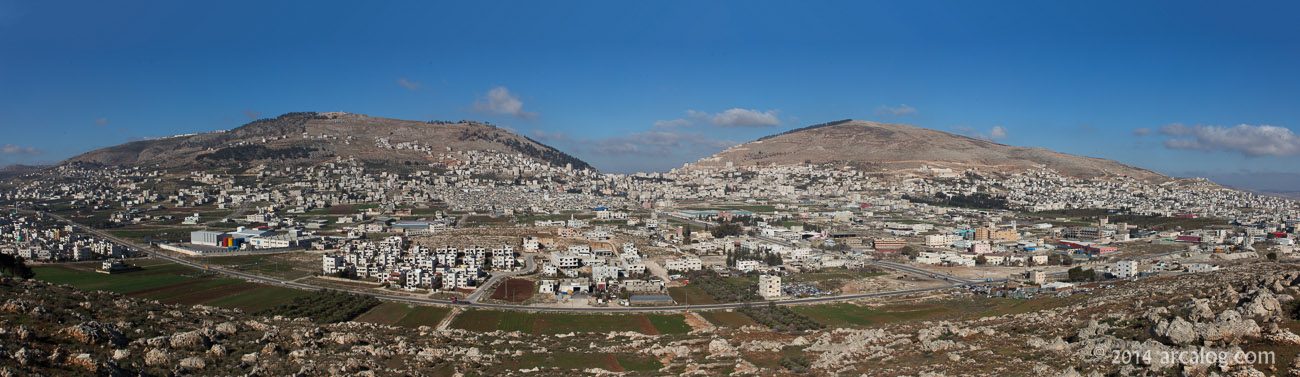
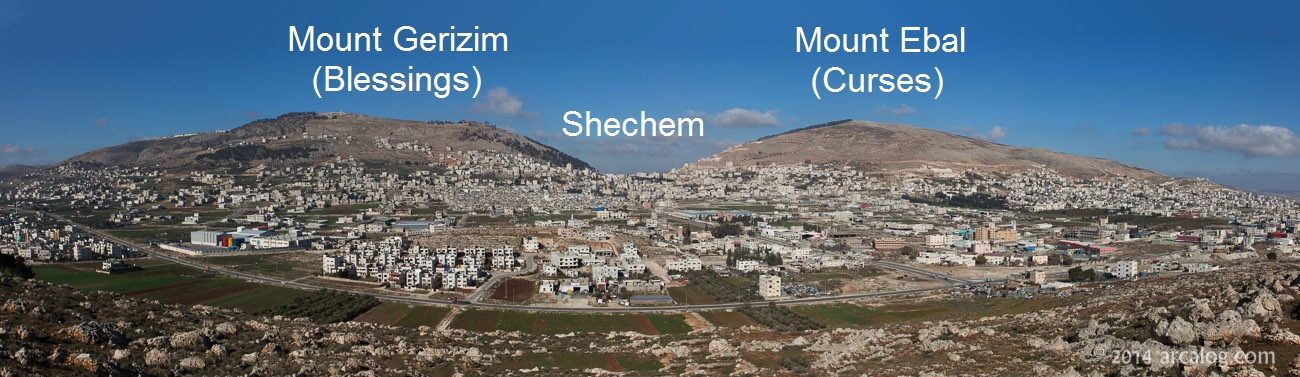
As I noted in the Torah portion R'ey, in the book of Deuteronomy, according to Bill Cloud of Shoreshim Ministries, the two mountains resemble the shoulder pieces of the High Priest. This image shows relation to the High Priest's shoulder pieces to the two mountains
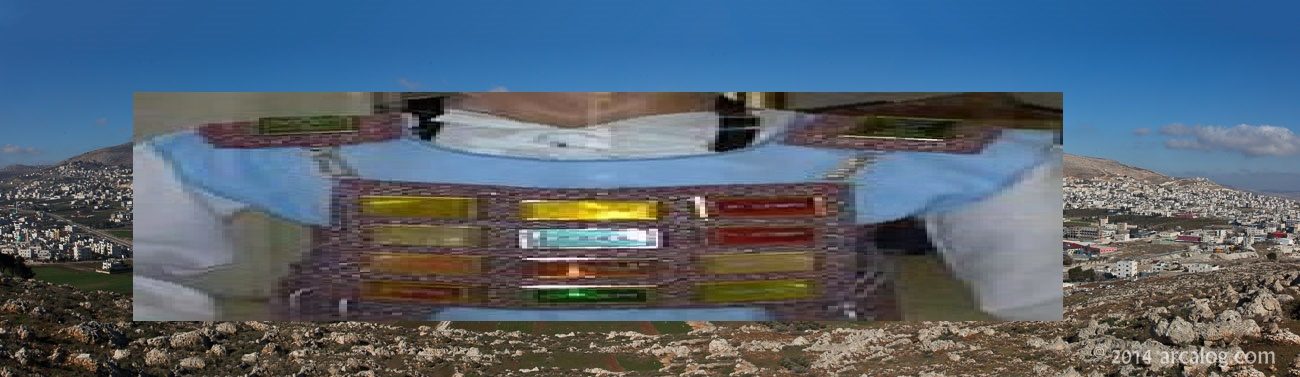
Jim Staley, formerly of Passion For Truth Ministries, noted that Mount Gerizim has greenery, while Mount Ebal is bare with rocks and stone.
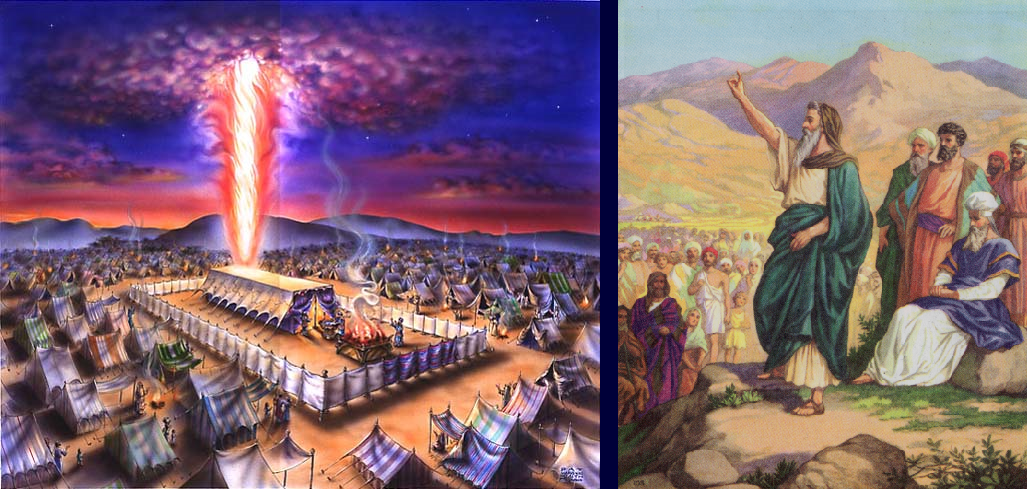
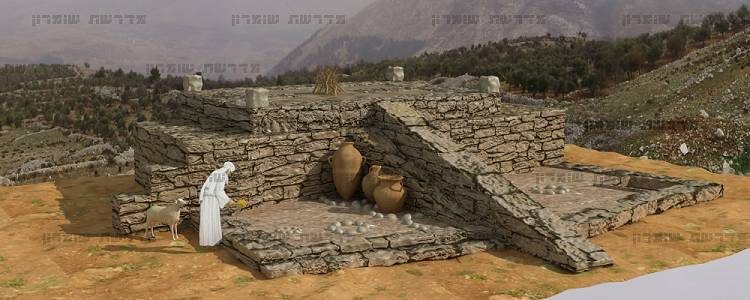
These are images of Joshua's Altar located on Mount Ebal
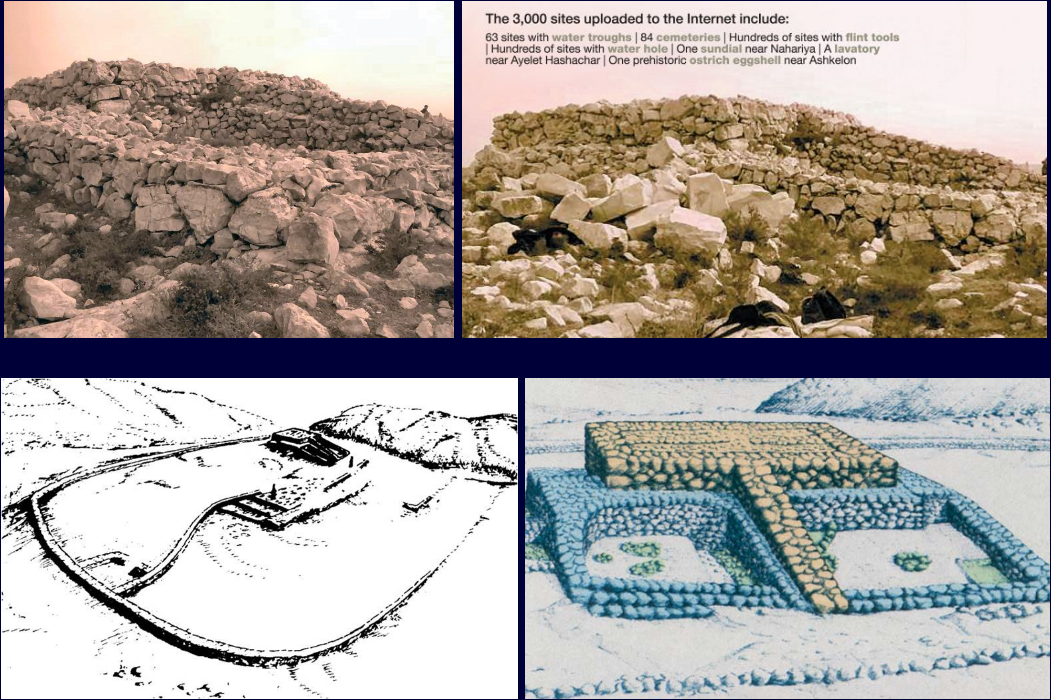
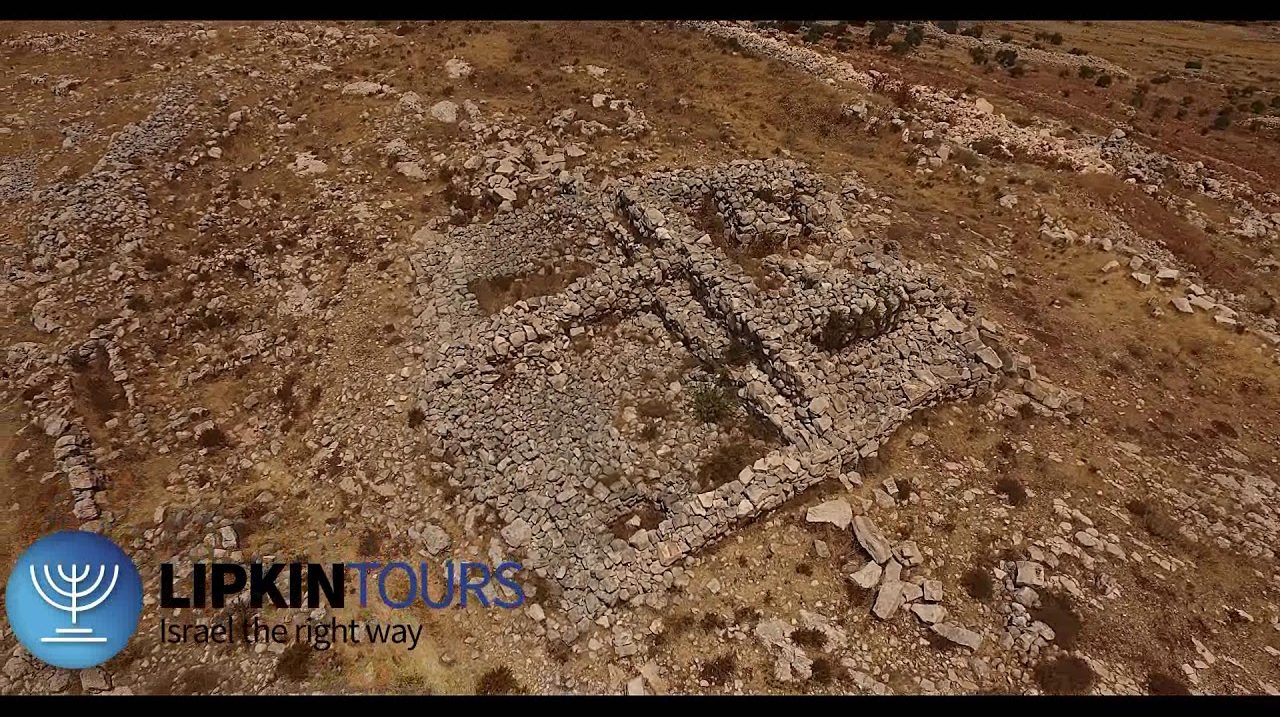
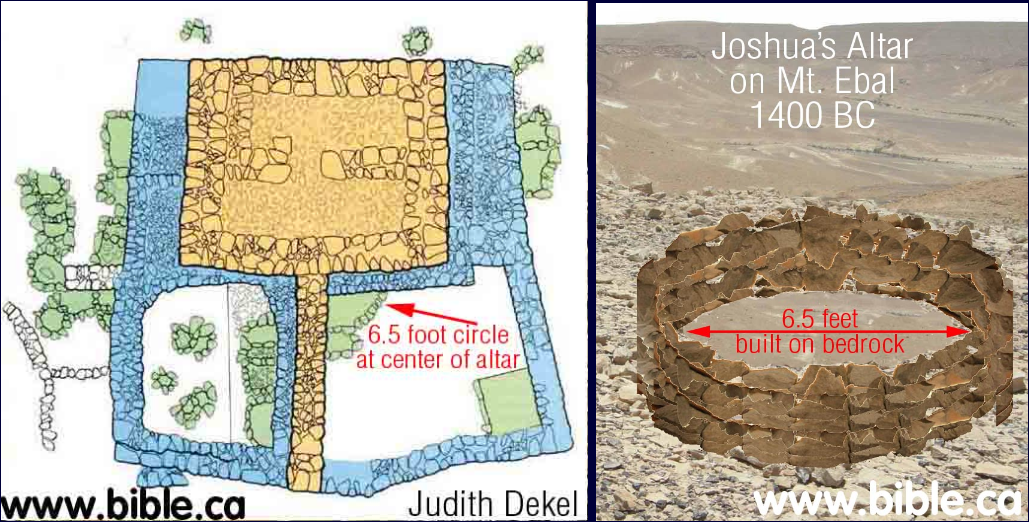
This is an image of what it could have looked like in its day
Verse twenty six
26 Ah'roor--Cursed who does not rises up (lifts up) all of את-the Words of this Teaching (Torah) to do them. And all of the People shall say, Amen.
Monte Judah of Lion and Lamb Ministries noted that the apostle Paul took this week's Torah portion passage and applied it in his letter to the assembly in Rome
Romans 3:23 For all have sinned, and come short of the Glory of hwhy;
Though hwhy wanted them to do all of His Torah, He knew that was humanely impossible. Adding on to Monte's note, Yeshua was the only one that could do all the Torah perfectly, because He is Perfect. He lives in us, so that He can do the Torah through us as long as we submit to Him.
Each verse begins with the word "cursed"
Looking at the word AH'ROOR-CURSE
The Hebrew word ah'roor-curse is "ah-rahr"- Aleph, Resh, Resh (ארר). It is from Strong's Concordance number 779, and its definition
A primitive root; to execrate: - X bitterly curse.
This is where we get our modern English word "error".
Monte Judah of Lion and Lamb Ministries noted a connection to the curses, which the apostle Paul noted in his letter to the assembly in Galatia
Galatians 3:10 For as many as are of the works of the Torah are under the curse: for it is written, Cursed is every one that continueth not in all things which are written in the book of the Torah to do them.
Monte also noted that these issues related to these curses are related to things that are done "in secret", and he's right. All of these issues are done behind close doors.
Jim Staley, formerly of Passion for Truth ministries, asked the question "Is the altar Joshua erected in Shechem, the same location of Moreh where Abraham was located and where Jacob buried the strange elohim"? It is probable.
In ending this week's Torah portion chapter, Ephraim Judah of Lion and Lamb Ministries noted that the word "Amen" is used only fourteen times in the Torah, and they were used "only" when there were curses. Twelve of them occur in this week's Torah portion chapter, and the other two regards the woman who takes the Oath of the Cursing if her husband has a Spirit of Jealousy come upon him against her by saying that she has commited adultery with another man, which is noted in the Torah portion of Naso, in the book of Numbers
Numbers 5:21 And the Priest shall make את-the woman swear on an Oath of the Allah-Curse (Imprecation), and the Priest shall say to the woman, יהוה shall give for an allah-curse (imprecation) with you and to an oath in the midst of your People in יהוה giving את-your genitals at falling off, and את-your womb at swelling (amassing, armying); 22 And the Waters of these Curses, they shall go in your uterus to swell (amass, army) the womb, and to make the genitals fall off: and the woman shall say, Amen, amen.
CHAPTER 28
Deuteronomy 28:1-28; 29:1
(Deuteronomy 28:1-29 in the Hebrew)
Deu 28:1 And shall be, if listening, you will listen in the Voice of יהוה, your Elohim, to guard (observe, take heed) to do all of את-His Commandments which I am commanding you the day (today), and יהוה, your Elohim, will give you high (exalted) above (upon) all nations of the Earth: 2 And all of these blessings, they shall come upon you, and shall attain (reach) of you, if you will listen in the Voice of יהוה, your Elohim. 3 Blessed you shall be in the city, and blessed you shall be in the field. 4 Blessed shall be the fruit of your womb (belly), and the fruit of your ground, and the fruit of your animals, the offspring (ejected out) of your tamed oxen, and the accumulation (increase, enrichment) of your flock. 5 Blessed shall be your weaving basket and your kneading trough. 6 Blessed you shall be in your coming, and blessed you shall be in your going out. 7 יהוה shall give את-your enemies that shall rise upon you be smitten (nagaph-stricken, gored) to your face: they shall come out to you in one direction (way), and in seven directions (ways), they shall flee to your face.
8 יהוה shall command with you את-the blessing in your storehouses, and in all you send forth your hand; and shall bless you in the land which יהוה, your Elohim, is giving to you. 9 יהוה shall raise (establish, erect) you to Himself for a Sacred (Holy) People as the which was sworn to you if you shall guard (observe, take heed of) את-the Commandments of יהוה, your Elohim, and you walk in His Ways. 10 And all of the peoples of the Earth, they shall see that the Name of יהוה is called upon you; and they shall fear from you. 11 And יהוה shall make you plenteous (exceed, excess) for goodness, in the fruit of your womb (belly), and in the fruit of your animals, and in the fruit of your ground, upon the Ground which יהוה swore to your fathers to give to you. 12 יהוה shall open to you את-His Good Treasure House at את-the Heavens to give the mater-rain to your land in His Season (Time), and to bless all of the work of your hand: and you shall lend mutliple nations, and you, you shall not be lent (borrow). 13 And יהוה shall give you for the head, and not for the tail; and you shall be only for above, and you shall not be for below; if you will listen to the Commandments of יהוה, your Elohim, which I am commanding you the day (today), to guard (observe, take heed) and to do them: 14 and you shall not turn rightward and smallward (leftward) from any of the Words which I am commanding you the day (today) to walk after other elohim to serve them.
15 And shall be, if you will not listen in the Voice of יהוה, your Elohim, to guard (observe, take heed) to do את-all of His Commandments and His Statutes which I am commanding you the day (today); and they shall come upon you all of these despisements (kalal-curses), and shall attain (reach) you:
16 Ah'roor-Cursed you shall be in the city, and ah'roor-cursed you shall be in the field. 17 Ah'roor-Cursed shall be your weaving basket and your kneading trough. 18 Ah'roor-Cursed shall be the fruit of your womb (belly), and the fruit of your ground, the offspring (ejected out) of your tamed oxen, and the accumulation (increase, enrichment) of your flock. 19 Ah'roor-Cursed you shall be in your coming, and ah'roor-cursed you shall be in your going out. 20 יהוה shall send on you את-the ah'roor-curse, and את-the confusion (discomfiture), and את-the rebuke (reproof, chiding) in all you send forth your hand which you shall do until you are destroyed (desolated), and until you perish hastily; from the face of the evil (evilness) of your maltreatments (imposings, gleanings, acts) which you have forsaken Me. 21 יהוה shall make את-the pestilence cling on you, until He has finished (rid) you from upon the Ground which you are going there to possess (occupy) her. 22 יהוה shall ya'khah-strike you on the emaciation (peeling), and on the fever (burning fever), and with the inflammation (inflaming fever), and on the extreme burning (extreme burning fever, glow), and on the sword, and on the scorching (blasting, blight), and on the paleness (pale greenness, yellowish-green, spittingness, mildew); and they shall pursue (chase) you until you perish.
23 And your Heavens which are over (upon) your head shall be copper, and the Earth which is under you shall be iron. 24 And יהוה shall give את-the mater-rain of your land powder and dust (ash): shall descend upon you from the Heavens until you are destroyed.
25 יהוה shall give you to be smitten (nagaph-stricken, gored) to the face of your enemies: in one direction (way) you shall go out to him, and in seven directions (ways) you shall flee to his face: and you shall be of a shaking (trembling, agitation) to all of the kingdoms of the Earth. 26 And your carcass (flabby carcass, wilted carcass) shall be for food for all of the birds of the Heavens, and for the animals of the Earth, and shall not be shuddered (anxious).
27 יהוה shall ya'khah-strike you on the boils of Egypt, and on the hemorroids, and on the scratching (scab, ?scurf?, ?scurvy?), and on the itch (scraping), which you are not able to be healed. 28 יהוה shall ya'khah-strike you on madness (craziness), and on blindness, and on astonishment (consternation, amazement) of heart:
29 And you shall be groping in the noonday, as which shall grope the blind in duskiness (gloominess), and you shall not prosper את-your ways: and you shall be only oppressed and plundered (plucked) all of the days, and no one shall be saved.
30 You shall betroth a woman, and another man shall copulate (ravish) her: you shall build a house, and you shall not dwell in him: you shall plant a vineyard, and you shall not begin him.
31 Your ox shall be slaughtered to your eyes, and you shall not eat of him: your donkey shall be robbed (plucked) from of your face, and shall not be returned to you: your flock shall be given to your enemies, and none to you shall be saved.
32 Your sons and your daughters shall be given to another people, and your eyes shall see and shall pine (fail) to them all of the day: and shall be nothing to power your hand.
33 The fruit of your ground and all of your toils shall be eaten of a people which you do not know; and you shall be only oppressed and crushed (cracked, bruised) all of the days:
34 And you shall be with madness (raving, ?insanity?) from the appearance of your eyes which you shall see. 35 יהוה shall ya'khah-strike you on an evil boil upon the knees and upon the legs which you are not able to heal (be healed), from the sole of your foot and unto your crown.
36 יהוה shall have you and את-your king which you raised (made raise) upon you go to a nation which you and your fathers have not known; and you shall serve other elohim of tree and stone, 37 and you shall be for a waste (ruin, stun, devastation), for a proverb, and for a taunt (gibe, byword) among all of the peoples which יהוה shall drive (?sigh?) you there.
38 You shall have go out multiple seed to the field, and you shall gather little; for the grasshopper shall devour him.
39 You shall plant vineyards, and you shall serve, and you shall not imbibe (drink) of the wine, and you shall not agriculterate; for the worms, they shall eat.
40 Olive trees, they shall belong to you in all of your border, and oil you shall not smear (soak); for your olives shall be plucked off (loosened, dropped off).
41 You shall birth sons and daughters, and they shall not belong to you; for they shall go in the captivity.
42 All of your trees and the fruits of your ground shall the cricket possess (occupy).
43 The sojourner which is at your drawing nearness shall ascend upon (above) you with the upward, with the upward; and you shall descend with the downward, with the downward.
44 He shall lend you, and you, you shall not lend him: he shall be for the head, and you, you shall be for the tail.
45 And all of these despisements (kalal-curses), they shall come upon you, and shall pursue (chase) you, and shall attain (reach, overtake) you until you are destroyed; for you did not listen in the Voice of יהוה, your Elohim, to guard (observe, take heed of) His Commandments and His Statutes which was commanded at you: 46 and they shall be on you for a Sign and for a Wonder and on your seed unto ages, 47 under which you did not serve יהוה-את, your Elohim, in joyfulness and in goodness of heart from multitude of all; 48 And you shall serve את-your enemies which יהוה shall send forth against you in hunger (famine), and in thirst, and in nakedness, and in want (poverty, lack) of all: and shall give a yoke of iron upon your back neck until He has destroyed you.
49 יהוה shall lift up (carry) a nation upon you from afar (a far off) from the ends of the Earth, as the which the eagle darts (swoops down); a nation of which to his tongue you have not heard; 50 a fierce nation of faces which shall not regard (lift up) faces, and shall not favor to the old and the young: 51 And shall eat the fruit of your animals and the fruit of your ground until you are destroyed: which shall not be sha'ahr-remained for (to) you grain, new wine, and pressed oil (glistened oil), the offspring (ejected out) of your tamed oxen, and the accumulation, (increase, riches) of your flock, until He has perished you. 52 And shall besiege (lay seige) to you against all of your gates until your lofty (exalted, haughty) and fortified (fenced, inaccessible) walls shall be descended (brought down) which you have confidence (made refuge, trusted) in them in all of your land: and shall be besieged (laid seige) to you in all of your gates in all of your land which יהוה, your Elohim, is giving to you.
53 And you shall eat the fruit of your womb (belly), the flesh of your sons and of your daughters, which יהוה, your Elohim, has given to you, in the siege (besiegment) and in the confinement (constrainment, distress, narrowness) which your enemy shall constrain (confine) to you: 54 the tender man among you and much delicate; his eye, she shall be evil against his brother, and against the woman (wife) of his bosom, and against the yether-leftover of his sons who shall be yether-left: 55 from giving to one from them from the flesh of his sons which shall be eaten: with failing leaving to him anything in the siege and in the constraint (confinement) which your enemies shall constrain (confine) to you in all of your gates. 56 The tender and the delicate female among you which did not tempt (test, prove) the cup (sole) of her foot to yah'tsahg-place (yah'tsahg-present) upon the Ground with delicateness and with tenderness, her eye, she shall be evil against the man of her bosom, and against her son, and against her daughter, 57 and against her newborn that came out from between her feet, and against her son which she birthed: for she shall eat them in want (lack) of all in the sether-secrecy, in the siege (besiegment), and in the constraint (confinement) which your enemy shall constrain (confine) to you in your gates.
58 If you will not guard (observe, take heed) to do את-all of the Words of this Teaching (Torah) that are written in this Scroll, to revere (fear, give awe at) את-this Glorious and Revering (Fearful, Aweing) Name, יהוה את, your Elohim; 59 and יהוה will make wondrous את-your ya'khah-strikings, and את the ya'khah-strikings of your seed shall be great and continuous ya'khah-strikings and evil and continuous sicknesses, 60 and shall return on you את all of the diseases of Egypt which you were afraid from their faces; and they shall cling on you. 61 Also every sickness and every ya'khah-striking which is not written in the Scroll of this Teaching (Torah), יהוה shall ascend them upon you until you are destroyed. 62 And you shall sha'ahr-remain among a few adult men under which you were as the stars of the Heavens for the multitude; for you would not listen in the Voice of יהוה, your Elohim.
63 And shall be, as which יהוה sahs-rejoiced upon (over) you to do you good and to multiply you; so shall יהוה will ya'sees-rejoice upon you to perish you and to have you destroyed; and you shall be uprooted (plucked up) from upon the Ground which you are coming there to possess (occupy) her, 64 and יהוה shall scatter you among all of the peoples from the end of the Earth and unto the end of the Earth; and there you shall serve other elohim of tree and stone which you and your fathers have not known. 65 And you shall not find ease (settlement) among these nations, and shall not be rest for the sole of your foot: and יהוה shall give to you there a heart of trembling (shaking, quivering, startling), and a consumption (finishing) of the eyes, and a sorrowing (pining) of the soul: 66 and your life shall be of uncertainty (doubt) to you from before (the front); and you shall be startled (afraid) nightly and daily, and you shall not have surety (assurance, certainty, belief, faith) in your life: 67 In the breaking period (morning) you shall say, Who shall give mixing period (eventing)?!, and in the mixing period (evening) you shall say, Who shall give breaking period (morning)?!, From the dreadness of your heart which you shall dread, and from the sight of your eyes which you shall see. 68 And יהוה shall return you at Egypt on ships on the way which I said to you, You shall not to see her again (adding) anymore: and you shall be sold there to your enemies for male slaves and for female slaves, and no one shall buy (purchase).
(NOTE: Not all verses will have comments)
Verse seven
7 יהוה shall give את-your enemies that shall rise upon you be smitten (nagaph-stricken, gored) to your face: they shall come out to you in one direction (way), and in seven directions (ways), they shall flee to your face.
King David probably based this week's Torah portion passage in the book of the Psalms
Psalm 91:7 A thousand shall fall at thy side, and ten thousand at thy right hand; but it shall not come nigh thee.
Verse fourteen
14 and you shall not turn rightward and smallward (leftward) from any of the Words which I am commanding you the day (today) to walk after other elohim to serve them.
Israel did exactly that, after they had settled in the land within years after Joshua died, and from the book of the Judges to their exile and captivity in the book of the Kings and Chronicles, and during the time of Yeshua until their dispersion forty years after His resurrection.
Indirectly related, this is similar to Yeshua said to His disciples to not follow false Messiahs and false prophets, which is noted in the Gospels of Matthew and Luke
Matthew 24:5 For many shall come in My Name, saying, I am Messiah; and shall deceive many.... 11 And many false prophets shall rise, and shall deceive many. 12 And because iniquity shall abound, the love of many shall wax cold. 13 But he that shall endure unto the end, the same shall be saved.... 23 Then if any man shall say unto you, Lo, here is Messiah, or there; believe it not. 24 For there shall arise false messiahs, and false prophets, and shall shew great signs and wonders; insomuch that, if it were possible, they shall deceive the very elect. 25 Behold, I have told you before. 26 Wherefore if they shall say unto you, Behold, He is in the desert; go not forth: behold, He is in the secret chambers; believe it not. 27 For as the lightning cometh out of the east, and shineth even unto the west; so shall also the coming of the Son of Man be.
Luke 21:8 And He said, Take heed that ye be not deceived: for many shall come in My Name, saying, I am; and the time draweth near: go ye not therefore after them.
Verses one through fourteen of this week's Torah portion chapter regarding the blessings can be compared to what king David noted in the book of the Psalms
Psalm 91:1 He that dwelleth in the secret place of the Most High shall abide under the shadow of the Almighty. 2 I will say of יהוה, He is my Refuge and my Fortress: my Elohim; in Him will I trust. 3 Surely He shall deliver thee from the snare of the fowler, and from the noisome pestilence. 4 He shall cover thee with his feathers, and under His Wings shalt thou trust: His truth shall be thy Shield and Buckler. 5 Thou shalt not be afraid for the terror by night; nor for the arrow that flieth by day; 6 Nor for the pestilence that walketh in darkness; nor for the destruction that wasteth at noonday. 7 A thousand shall fall at thy side, and ten thousand at thy right hand; but it shall not come nigh thee. 8 Only with thine eyes shalt thou behold and see the reward of the wicked. 9 Because thou hast made יהוה, which is my Refuge, even the Most High, thy Habitation; 10 There shall no evil befall thee, neither shall any plague come nigh thy dwelling. 11 For He shall give His angels charge over thee, to keep thee in all thy ways. 12 They shall bear thee up in their hands, lest thou dash thy foot against a stone. 13 Thou shalt tread upon the lion and adder: the young lion and the dragon shalt thou trample under feet. 14 Because He hath set His Love upon me, therefore will I deliver Him: I will set Him on high, because He hath known my name. 15 He shall call upon me, and I will answer Him: I will be with Him in trouble; I will deliver Him, and honour Him. 16 With long life will I satisfy Him, and shew Him my salvation.
Verses twenty three and twenty four
23 And your Heavens which are over (upon) your head shall be copper, and the Earth which is under you shall be iron. 24 And יהוה shall give את-the mater-rain of your land powder and dust (ash): shall descend upon you from the Heavens until you are destroyed.
This was a very harsh and severe judgment by making the heavens and the earth so hard that hwhy was to make them like solid metals. This could be Israel's potential reaping from יהוה sowing the copper heavens and the iron earth by making their hearts hard like stone, but in this case they would make their hearts symbolically like "copper and iron".
Verses twenty seven and twenty eight
27 יהוה shall ya'khah-strike you on the boils of Egypt, and on the hemorroids, and on the scratching (scab, ?scurf?, ?scurvy?), and on the itch (scraping), which you are not able to be healed. 28 יהוה shall ya'khah-strike you on madness (craziness), and on blindness, and on astonishment (consternation, amazement) of heart:
Looking at the word ITCH
The Hebrew word for itch is "kheh-rehs"- Khet, Resh, Samek (חרס). It is from Strong's Concordance number 2775, and its definition
From an unused root meaning to scrape; the itch; also (perhaps from the mediating idea of H2777) the sun: - itch, sun.
This is where we get our modern English word "harass", for it is harassing to continuously bear an itch that cannot be stopped. This could be an indirectly related connection to the apostle Paul pleading to the Heavenly Father regarding the thorn of his flesh, which he noted in his letter to the assembly in Corinth
2 Corinthians 12:5 Of such an one will I glory: yet of myself I will not glory, but in mine infirmities. 6 For though I would desire to glory, I shall not be a fool; for I will say the truth: but now I forbear, lest any man should think of me above that which he seeth me to be, or that he heareth of me. 7 And lest I should be exalted above measure through the abundance of the revelations, there was given to me a thorn in the flesh, the messenger of Satan to buffet me, lest I should be exalted above measure. 8 For this thing I besought the Lord thrice, that it might depart from me. 9 And he said unto me, My Grace is sufficient for thee: for My Strength is made perfect in weakness. Most gladly therefore will I rather glory in my infirmities, that the Power of Messiah may rest upon me. 10 Therefore I take pleasure in infirmities, in reproaches, in necessities, in persecutions, in distresses for Messiah's sake: for when I am weak, then am I strong.
Paul's thorn was like a symbolic itch that the Lord would not take away from Paul. How many of us are experiencing our own "thorns", our symbolic itches.
Verse twenty nine
29 And you shall be groping in the noonday, as which shall grope the blind in duskiness (gloominess),...
Looking at the word NOONDAY
The Hebrew word for noonday is "tsoh-hahr"- Tsade, Heh, Resh (צהר). It is from Strong's Concordance number 6672, and its definition
From H6671; a light (that is, window); dual double light, that is, noon: - midday, noon (-day, -tide), window.
from 6671 "tsah-hahr" (צהר), and its definition
A primitive root; to glisten; used only as denominative from H3323, to press out oil: - make oil.
Mark Biltz of El Shaddai Ministries noted a connection of this week's Torah portion passage, which is noted in the book of the prophet Amos
Amos 8:9 And it shall come to pass in that day, saith Adonai יהוה, that I will cause the sun to go down at noon, and I will darken the earth in the clear day: 10 And I will turn your feasts into mourning, and all your songs into lamentation; and I will bring up sackcloth upon all loins, and baldness upon every head; and I will make it as the mourning of an only son, and the end thereof as a bitter day.
The word "noon" is the same Hebrew word "tsohar". Then Mark tied this prophecy to an account, which is noted in the Gospel of Luke
Luke 23:44 And it was about the sixth hour, and there was a darkness over all the earth until the ninth hour. 45 And the sun was darkened, and the Veil of the Temple was rent in the midst.
The sixth hour of the day was at "noon", and the sun- a symbol of the Heavenly Father which was based on Joseph's second dream that the sun, the moon and the stars would bow and worshipped him, which is noted in the Torah portion of Vay-Yeyshev, in the book of Genesis
Genesis 37:9 And dreamed still (yet) another dream, and accounted (scribed, enumerated, enrolled, scrolled) him to his brothers, and said, Behold, I have still (still have) calm-dreamed a calm-dream; and behold, the sun and the moon and the one ten (oneteen, eleven) stars were bowing to me. 10 And was accounted (scribed, enumerated, enrolled, scrolled) to his father, and to his brothers: and his father rebuked (reproved) against him, and said to him, What is this calm-dream which you have calm-dreamed? That coming, I and your mother and your brothers, we shall come to bow to you to the Earth?
The Heavenly Father, the symbol of the sun, symbolically turned His Face away from His Son, Yeshua, by symbolically causing the sun to turn "supernaturally dark", while Yeshua was crucified on the Cross. This fulfilled the "Noonday Phophecy" in the Amos passage as well as this week's Torah portion passage. Thank you Abba Father for Mark Biltz, and thank you Mark for revealing this.
!!!כבד לך יהוה
Verses fifty three through fifty seven
53 And you shall eat the fruit of your womb (belly), the flesh of your sons and of your daughters, which יהוה, your Elohim, has given to you, in the siege (besiegment) and in the confinement (constrainment, distress, narrowness) which your enemy shall constrain (confine) to you: 54 the tender man among you and much delicate; his eye, she shall be evil against his brother, and against the woman (wife) of his bosom, and against the yether-leftover of his sons who shall be yether-left: 55 from giving to one from them from the flesh of his sons which shall be eaten: with failing leaving to him anything in the siege and in the constraint (confinement) which your enemies shall constrain (confine) to you in all of your gates. 56 The tender and the delicate female among you which did not tempt (test, prove) the cup (sole) of her foot to yah'tsahg-place (yah'tsahg-present) upon the Ground with delicateness and with tenderness, her eye, she shall be evil against the man of her bosom, and against her son, and against her daughter, 57 and against her newborn that came out from between her feet, and against her son which she birthed: for she shall eat them in want (lack) of all in the sether-secrecy, in the siege (besiegment), and in the constraint (confinement) which your enemy shall constrain (confine) to you in your gates.
There is a Biblical account of this curse, which is noted in the book of the Kings
2 Kings 6:26 And as the king of Israel was passing by upon the wall, there cried a woman unto him, saying, Help, my lord, O king. 27 And he said, If hwhy do not help thee, whence shall I help thee? Out of the barnfloor, or out of the winepress? 28 And the king said unto her, What aileth thee? And she answered, This woman said unto me, Give thy son, that we may eat him to day, and we will eat my son to morrow. 29 So we boiled my son, and did eat him: and I said unto her on the next day, Give thy son, that we may eat him: and she hath hid her son. 30 And it came to pass, when the king heard the words of the woman, that he rent his clothes; and he passed by upon the wall, and the people looked, and, behold, he had sackcloth within upon his flesh.
The judgment came upon them during the reign of King Jehoram, who says was the son of Ahab, but was really his son-in-law, as I made note in my teaching "Joram And Jehoram". It was on his watch that this curse was manifested in the Northern Kingdom of the Ten Northern Tribes of Israel.
This curse also took place in Jerusalem around 70 AD. Flavius Josephus, a Jewish historian, was alive during the destruction of Jerusalem. He archived the account in his book series "The Wars of the Jews". This account regarding barbaric practices is located in Book six, chapter three, starting on section four
Book VI, Chapter III, Section 4 (Entire)
Another Description Of The Terrible Famine That Was In The City
"4. Now there was a certain woman that dwelt beyond Jordan, her name was Mary; her father was Eleazar, of the village Bethezub, which signifies the House of Hyssop. She was eminent for her family and her wealth, and had fled away to Jerusalem with the rest of the multitude , and was with them besieged therein at this time. The other effects of this woman had been already seized upon; such I mean as she had brought with her out of Perea, and removed to the city. What she had treasured up besides, as also what food she had contrived to save, had also been carried off by the rapacious guards, who came every day running into her house for that purpose. This put the poor woman into a very great passion, and by the frequent reproaches and imprecations she cast at these rapacious villains, she had provoked them to anger against her; but none of them, either out of the indignation she had raised against herself, or out of the commiseration of her case, would take away her life ; and if she found any food, she perceived her labours were for others, and not for herself; and it was now become impossible for her any way to find any more food, while the famine pierced through her very bowels and marrow, when also her passion was fired to a degree beyond the famine itself: nor did she consult with anything but with her passion and the necessity she was in. She then attempted a most unnatural thing; and snatching up her son, who was a child sucking at her breast, she said, "O thou miserable infant! for whom shall I preserve thee in this war, this famine, and this sedition ? As to the war with the Romans, if they preserve our lives, we must be slaves! The famine also will destroy us, even before that slavery comes upon us; yet are these seditious rogues more terrible than both the other. Come on; be thou my food, and be thou a fury to these seditious varlets and a byeword to the world, which is all that is now wanting to complete the calamities of us Jews." As soon as she had said this, she slew her son; and then roasted him, and ate one half of him , and kept the other half by her concealed. Upon this the seditious come in presently, and smelling the horrid scent of this food, they threatened her that they would cut her throat immediately if she did not shew them what food she had gotten ready. She replied, that she had saved a very fine portion of it for them; and withal uncovered what was left of her son. Hereupon they were seized with a horror and amazement of mind, and stood astonished at the sight; when she said to them "This is mine own son; and what hath been done was mine own doing! Come, eat of this food; for I have eaten of it myself! Do not you pretend to be either more tender than a woman, or more compassionate than a mother; but if you be so scrupulous, and do abominate this my sacrifice, as I have eaten the one half, let the rest be reserved for me also." After which, those men went out trembling, being never so much affrighted at anything as they were at this, and with some difficulty they left the rest of that meat to the mother. Upon which, the whole city was full of horrid action immediately; and while everyone laid this miserable case before their own eyes, they trembled, as if this unheard-of-action had been done by themselves. So those that were thus distressed by the famine were very desirous to die ; and those already dead were esteemed happy, because they had not live long enough either to hear or see such miseries".
Verses sixty three through sixty eight
63 And shall be, as which יהוה sahs-rejoiced upon (over) you to do you good and to multiply you; so shall יהוה will ya'sees-rejoice upon you to perish you and to have you destroyed; and you shall be uprooted (plucked up) from upon the Ground which you are coming there to possess (occupy) her, 64 and יהוה shall scatter you among all of the peoples from the end of the Earth and unto the end of the Earth; and there you shall serve other elohim of tree and stone which you and your fathers have not known. 65 And you shall not find ease (settlement) among these nations, and shall not be rest for the sole of your foot: and יהוה shall give to you there a heart of trembling (shaking, quivering, startling), and a consumption (finishing) of the eyes, and a sorrowing (pining) of the soul: 66 and your life shall be of uncertainty (doubt) to you from before (the front); and you shall be startled (afraid) nightly and daily, and you shall not have surety (assurance, certainty, belief, faith) in your life: 67 In the breaking period (morning) you shall say, Who shall give mixing period (eventing)?!, and in the mixing period (evening) you shall say, Who shall give breaking period (morning)?!, From the dreadness of your heart which you shall dread, and from the sight of your eyes which you shall see. 68 And יהוה shall return you at Egypt on ships on the way which I said to you, You shall not to see her again (adding) anymore: and you shall be sold there to your enemies for male slaves and for female slaves, and no one shall buy (purchase).
This is what the Christians call "backsliding", but it also apply to us Messianics if we fall off the beaten path, from following Yeshua, and these thing will apply to us by being in the spiritual worldly empire and our souls being in uncertainty. Fallen of the spiritual eyes, and troubled heart and sorrowness of our souls, because we left our first love (Revelation have this kind of verse?)
Verses sixty three and sixty four
63 And shall be, as which יהוה sahs-rejoiced upon (over) you to do you good and to multiply you; so shall יהוה will ya'sees-rejoice upon you to perish you and to have you destroyed; and you shall be uprooted (plucked up) from upon the Ground which you are coming there to possess (occupy) her, 64 and יהוה shall scatter you among all of the peoples from the end of the Earth and unto the end of the Earth; and there you shall serve other elohim of tree and stone which you and your fathers have not known.
Yair Davidiy of Hebrew Nations and Brit Am, a Chasidic Jew, originally from Australia, now living in Jerusalem, who is not a believer in Yeshua, revealed in his book "The Tribes" that the Ten Northern Tribes were scattered throughout all of the nations of the earth, mostly in the Western European nations, North and South America, Australia and South Africa. This was because of their rebellion against hwhy and it caused them to be divorced from hwhy, as I mentioned in the Torah portion of Ki Theytsey, in the book of Deuteronomy. You can purchase his book by clicking on the image below to get to the webpage.
- - - - - - - - - - - - - - - - - - - - - - - - - - - - - - - - - - - - - - - - - - - - - - - - - - - - - - - - - - - - - - - -
DISCLAIMER
The views and opinions expressed, from these different formats of teachings below, are solely those of the personnel and do not necessarily reflect the views or opinions of The Aleph-Tav Project.
- - - - - - - - - - - - - - - - - - - - - - - - - - - - - - - - - - - - - - - - - - - - - - - - - - - - - - - - - - - - - - - -
YAIR DAVIDIY
The Tribes

Verse sixty five
65 And you shall not find ease (settlement) among these nations, and shall not be rest for the sole of your foot: and יהוה shall give to you there a heart of trembling (shaking, quivering, startling), and a consumption (finishing) of the eyes, and a sorrowing (pining) of the soul:
Looking at the word EASE
The Hebrew word for ease is "rah-gah"- Resh, Gimel, Ayin (רגע). It is from Strong's Concordance number 7280, and its definition
A primitive root; properly to toss violently and suddenly (the sea with waves, the skin with boils); figuratively (in a favorable manner) to settle, that is, quiet; specifically to wink (from the motion of the eye lids): - break, divide, find ease, be a moment, (cause, give, make to) rest, make suddenly.
Notice that the Hebrew word also translates as "to toss violently". This is the probably the word that the apostle Paul applied to the doctrine of men, which is noted in his letter to the assembly in Ephesus
Ephesians 4:11 And he gave some, apostles; and some, prophets; and some, evangelists; and some, pastors and teachers; 12 For the perfecting of the saints, for the work of the ministry, for the edifying of the Body of Messiah: 13 Till we all come in the unity of the faith, and of the knowledge of the Son of Elohim, unto a perfect man, unto the measure of the stature of the fulness of Messiah: 14 That we henceforth be no more children, tossed to and fro, and carried about with every wind of doctrine, by the sleight of men, and cunning craftiness, whereby they lie in wait to deceive; 15 But speaking the truth in love, may grow up into him in all things, which is the head, even Messiah: 16 From whom the whole body fitly joined together and compacted by that which every joint supplieth, according to the effectual working in the measure of every part, maketh increase of the body unto the edifying of itself in love.
Verse sixty six
66 and your life shall be of uncertainty (doubt) to you from before (the front); and you shall be startled (afraid) nightly and daily, and you shall not have surety (assurance, certainty, belief, faith) in your life:
This is how the King James Version translated this segment of this week's Torah portion passage
66 ...and thou shalt fear day and night,...
In the phrase "day and night", in the Hebrew text, it says "lai-lah v'yoh-mahm" (לילה ויומם). Laila is the Hebrew word for "nightly", and yomam is the Hebrew word for "daily". What this reveals to us is that Moses was going by the order of the proper Biblical day which begins at night, starting at sundown, and followed by the day time until the new day starts at night again. In my opinion, the King James translators we biased and anti-Jewish in this translation.
Verse sixty seven
67 In the breaking period (morning) you shall say, Who shall give mixing period (eventing)?!, and in the mixing period (evening) you shall say, Who shall give breaking period (morning)?!, From the dreadness of your heart which you shall dread, and from the sight of your eyes which you shall see.
I have personally experienced this verse myself in my early years of my spiritual walk in Yeshua. At a point in my life while I was in college. I went through an unknown pshychological and spiritual effect that put me in a state of uncertainty in my life. I personally wanted the day to come when it was night, and after night came, I was hoping for the day to appear. I wrote my personal account of it in one of my earlier Torah portion commentaries, and this was one of examples I hope that I would not want to go through again. Believe me when I say that it was very very hard in my life, it felt like I was spiritually uprooted without knowing where I was going to land.
Verse sixty eight
68 And יהוה shall return you at Egypt on ships on the way which I said to you, You shall not to see her again (adding) anymore: and you shall be sold there to your enemies for male slaves and for female slaves, and no one shall buy (purchase).
This is like what Joseph went through when his brothers sold him to Egypt, except by land instead of ships, but in this week's Torah portion passage, the Egyptians will not buy them. There is no aftermath to their lives after that. They were probably thrown out in the streets begging for food and trying to find means to survive until they died, or the Egyptian slave traders would just kill them, or in a hail mary pass, they were put into slavery from those who took them to Egypt. As far as we know, but there are no records of what happened to them who went through this process at this time.
I remembered in my college years that while in class, my professor wrote on the board this poem: "Cat, cat, cat, you made me glad, glad, glad. Cat, cat, cat, you made me sad". My professor asked if anyone had a comment on this poem. One of my colleagues in class raised her hand and said, paraphrasing, that when it says "glad, glad, glad" it shows how happy and joyful they are, but when it said "sad" only once, the impact of the negative word was strong and was equal, if not greater, to the three glads. Negatives give stronger impact than the postives, and in Moses' case, there were a lot of negatives, meaning that the consequences outweighs the incentives, meaning that incentives are more rare and more precious than consequences. This is similar to Pharaoh's dream in the book of Genesis regarding the seven fat cows and fat ears verses the seven skinny cows and whithered ears, which intrepreted as the seven years of plenty and the seven years of famine. This is what Joseph said after the interpretation of the seven years of famine, which is noted in the Torah portion of Mikeyts, in the book of Genesis
Genesis 41:30 and seven years of famine, they shall arise after them; and all of the plenty in the land of Egypt shall be forgotten; and the famine shall finish (end, cease) את-the land; 31 And the plenty shall not be known in the land from the face of that famine, after thus; for he shall be much (very) heavy.
Negatives do have a more imacting effect than postives. In this week's Torah portion, the curses are more effective than the blessings. As the former presidential candidate, Ross Perot, said from his famous words back in the 1992 Presidential Election campaign, "Words are few and deeds are precious". In this case, the fewer the incentives, the more precious they are when one obeys יהוה's Commandments.
This week's Torah portion's chapter reveals the blessings and the curses that impact the following: Locations, Land, Productivity, Agriculture, Weather, Offspring, Family Values, Health Issues, Psychological Values, Moral Values, Spiritual Issues, Relationships, Security, Foreigners, Wars, Foreign Elohim, and Residency.
I noted in the Torah portion of Shophtim the three things the Priest would say to the men of Israel to not fear, tremble and dread. These three aspects would affect the Israelites if they did not listen to the voice of hwhy their Elohim:
FEAR
The first one, fear, is a negative act of internal insecurity.
TREMBLE
The second one, tremble, is a negative physical act of having lack of strength.
DREAD
The third one, dread, is a negative psychological act which includes effecting the emotional and mental instability and the lack of discernment.
These are factors that would also effect the Israelites, because they rejected hearing the Voice and Word of hwhy.
This also applies to us today as believers who refuses to listen to the Voice of יהוה and walk in our own ways. I have heard people who strayed from the Will of יהוה. Some lost their health after they were healed, because they kept on doing things they should not have done. I have heard people reject their calling including one who came down with the case of schizophrenia. I pray that we hold, stand, and walk in the faith.
CHAPTER 29
Deuteronomy 29:1-9
(28:29-29:8 in the Hebrew)
Deu 29:1 These are the Words of the Covenant, which יהוה commanded את-Moses to make cut את-the Sons of Israel, in the land of Moab, from by apart of the Covenant which was cut of them in Horeb. 2 And Moses called to all of Israel, and said to them, You, you have seen את all which יהוה did to your eyes in the land of Egypt to Pharaoh, and to all of his servants, and to all of his land; 3 the Great Trials (Great Tests) which your eyes, they have seen, the Signs, and those Great Miracles (Wonders): 4 And יהוה has not given to you a heart to know, and eyes to see, and ears to hear, until this day. 5 And I have walked you [(made you go)] forty years in the wilderness: your clothes, they did not fail from upon you, and your sandals did not fail of her from upon your foot. 6 You have not eaten bread, and you have not imbibed (drank, tasted) wine and strong drink: by that, you may know that I am יהוה, your Elohim. 7 And you came to this place, and Sihon, King of Heshbon, and Og, King of the Bashan, came out to encounter (meet) us to the war, and we yah'khah-struck them: 8 and we took את-their land, and gave her for an inheritance to the Reubenites, and to the Gadites, and to the half tribe of the Manasseh. 9 And you shall guard (observe, take heed) את-the Words of this Covenant, and you shall do them, by that, you shall be skillful (prudent) at את all which you do.
(NOTE: Not all verses will have comments)
Verse one
1 These are the Words of the Covenant, which יהוה commanded את-Moses to make cut את-the Sons of Israel, in the land of Moab, from by apart of the Covenant which was cut of them in Horeb.
When Moses said the Covenant in the land of Moab apart the Covenant at Mount Sinai in the land of Midian, he meant "the Covenant of the Blessings and Curses" that he spoke in the previous chapter which He just spoke in the land of Moab, just south of the border, as this map belows shows
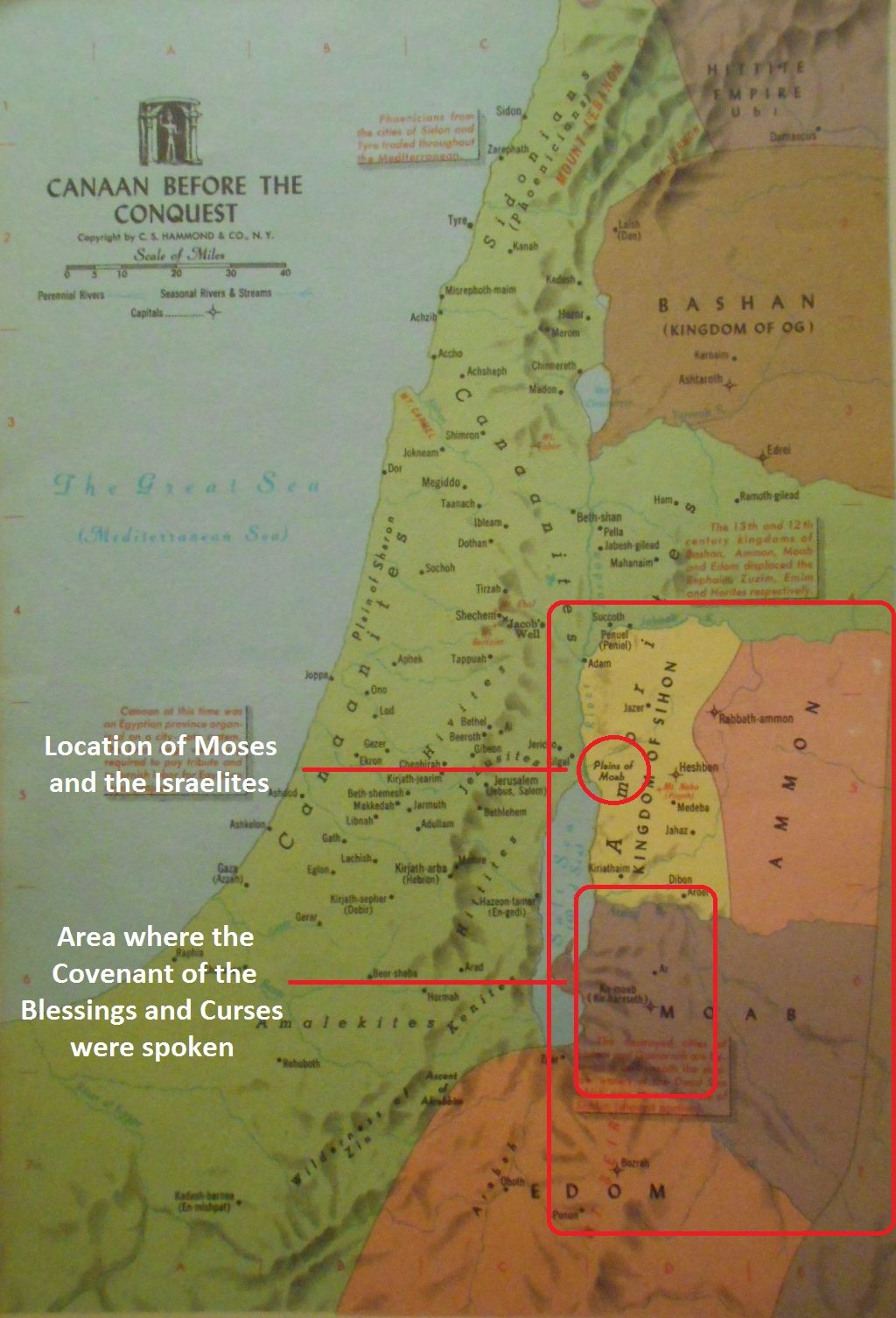
Verses five and six
5 And I have walked you [(made you go)] forty years in the wilderness: your clothes, they did not fail from upon you, and your sandals did not fail of her from upon your foot. 6 You have not eaten bread, and you have not imbibed (drank, tasted) wine and strong drink: by that, you may know that I am יהוה, your Elohim.
First of all, if one notices the verses before and after this week's Torah portion passage, Moses was talking to the Israelites in his own voice relating to what יהוה did. In these two verses of this week's Torah portion passage, the focus of the person changes from Moses talking about יהוה, to יהוה speaking in His own Voice.
Question: "Did יהוה actualy speak to the Israelites in His own Voice from the Pillar of the Cloud and/or the Pillar of Fire, or was this Moses' voice speaking on behelf of יהוה by speaking as if יהוה was speaking through Him"? Maybe it was the latter. I don't know, but I have been experiencing times where He was using my voice to speak to me directly. So it is possible that this was the case for Moses.
יהוה gave them two major miracles throughout their forty year journey:
One: They were fed with the manna
Two: Their clothing and sandals did not wear out
It is probable that Yeshua based this week's Torah portion passage in His teaching, which is noted in the Gospel of Matthew
Matthew 6:25 Therefore I say unto you, Take no thought for your life, what ye shall eat, or what ye shall drink; nor yet for your body, what ye shall put on. Is not the life more than meat, and the body than raiment? 26 Behold the fowls of the air: for they sow not, neither do they reap, nor gather into barns; yet your Heavenly Father feedeth them. Are ye not much better than they? 27 Which of you by taking thought can add one cubit unto his stature? 28 And why take ye thought for raiment? Consider the lilies of the field, how they grow; they toil not, neither do they spin: 29 And yet I say unto you, That even Solomon in all of his glory was not arrayed like one of these. 30 Wherefore, if יהוה so clothe the grass of the field, which to day is, and to morrow is cast into the oven, shall He not much more clothe you, O ye of little faith? 31 Therefore take no thought, saying, What shall we eat? Or, What shall we drink? Or, Wherewithal shall we be clothed? 32 (For after all of these things do the Gentiles seek:) for your Heavenly Father knoweth that ye have need of all of these things. 33 But seek ye first the Kingdom of hwhy, and His Righteousness; and all of these things shall be added unto you.
Adding to this, this is the part that Yeshua wants us as believers to pray, which is noted in the Gospel of Matthew
Matthew 6:9 After this manner therefore pray ye: Our Father who art in the Heavens, Hallowed be Thy Name. 10 Thy Kingdom come. Thy Will be done, as it is in the Heavens, so is on the Earth. 11 Give us this day our Daily Bread. 12 And forgive us our debts, as we forgive our debtors. 13 And lead us not into temptation, but deliver us from evil: For Thine is the Kingdom, and the Power, and the Glory, for ever. Amen.
In many ways, Yeshua told us to ask our Heavenly Father to provide for our daily needs, and to trust Him that He will do that.
This week's Torah portion passage also applies to us that we as believers in Yeshua are contiuously and eternally fed with His Word, and our spiritual garments are eternally not worn out.
That ends this week's Torah portion commentary.
Any questions or comments can be written to
thealeph-tavproject@outlook.com
SHABBATH SHALOM
